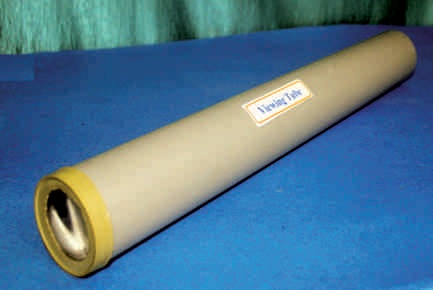
 In a water body like ponds, shallow water of lakes, oceans and rivers etc viewing aquatic animals gets disturbed by various factors including the turbidity of water, movement of the animals, hiding spaces inside water and also the distance of the viewer from the water level.
Viewing tube is the simple device that enables the naturalist to look inside shallow water and watch different life forms living in it up to the bottom. Viewing tube is a cylindrical narrow tube made of tough and light weight material with 2-3 inch diameter and length appropriate to dip it up to few feet under the water. Its one end (which is dipped inside water) is closed with transparent film or glass and the other end open outside water where the observer can fix eye and see the objects seen at the underwater end clearly. Viewing tube enables the viewer to reach closer to the aquatic life forms up to the bottom zone without disturbing them or handling them.
Efficiency of the viewing tube can be further strengthened by attaching a convex lens at the dipping end which would further magnify the view of the objects being seen. This further helps the viewer to see the underwater life forms, bottom structures and functions in a more distinct manner.