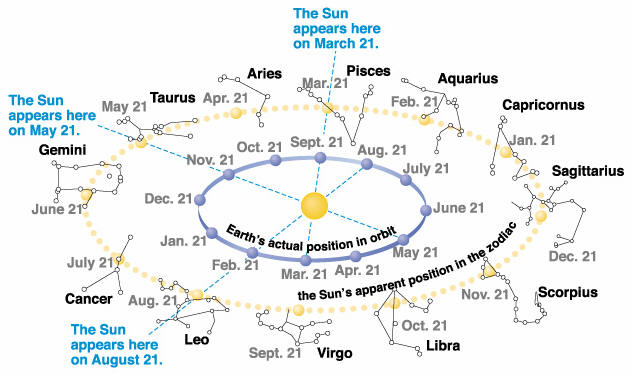
 The Sun, Moon and planets show a perceptible movement to the background of stars while the stars are so distant that they look stationary. Because of the Earth’s rotation we see the sky scrolling as if we are moving and the whole sky seems to turn the hours around. By this phenomenon we see the rise and set of the stars. In addition, the movement of the Earth in its orbit around the Sun also shows different portions of the sky round the year.
Every day the stars in the sky return to the same place 4 minutes early because the Earth’s orbital movement around the Sun gives a slightly different background of stars each night. This 4 minutes difference every day is because of the difference between the length of a day (24 hrs) and that of an Earth’s rotation (23 hours and 56 minutes).
The daily position of the stars in the sky over a static position on the Earth can be seen using manufactured or digital version of the ‘Tara Ghadi’ (Star Watch), which is designed for locating the position of stars above us in the sky. The Star Watch device consists of two major components – Star Wheel and Star Dial. Star wheel is fixed in the star dial in such a way that it can be rotated in the star dial. The star wheel is having the position of stars inscribed which is surrounded by the monthly calendar. Star dial is a time displaying tool with which the star wheel can be adjusted according to the particular day and time.