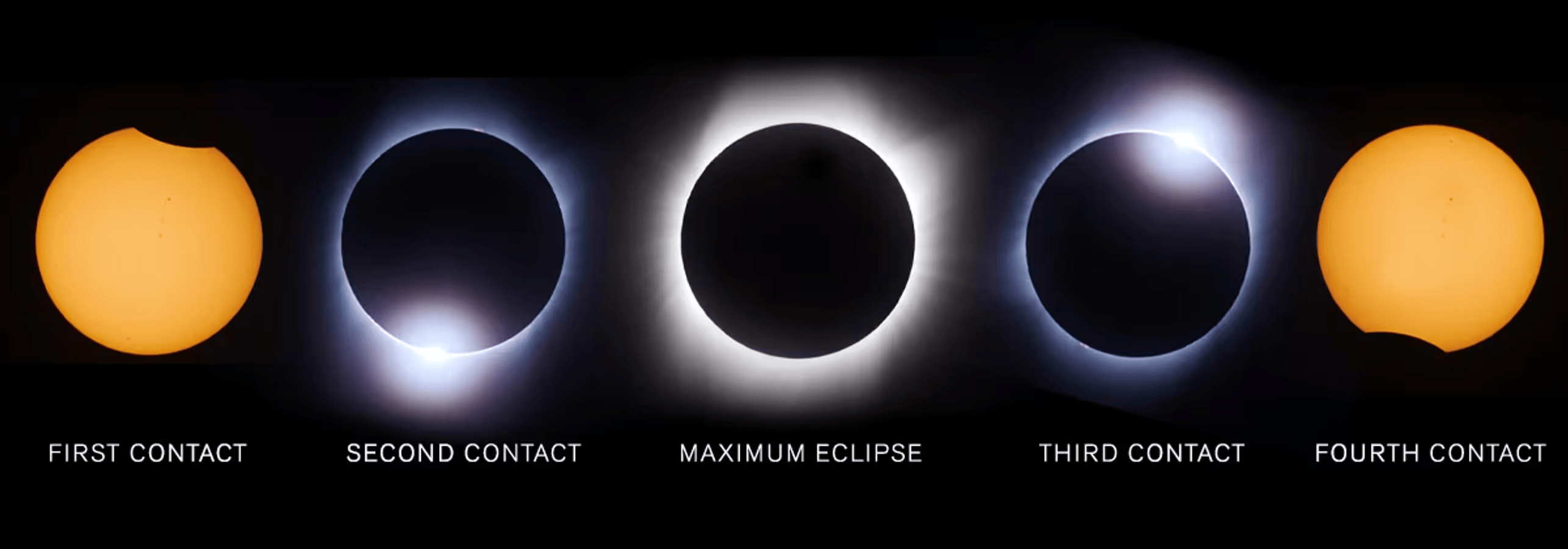
A solar eclipse occurs when the Moon passes between the Sun and Earth, casting a shadow on Earth that partially or fully blocks the sunlight in some areas. Solar eclipse only happens occasionally because the moon doesn’t orbit in the same plane as the Sun and Earth do. The time when all these three are aligned is called the eclipse season which happens twice a year. Solar eclipses are classified into total, annular, partial and hybrid types according to the position of the Moon between the Sun and Earth. Total Solar Eclipse happens when the moon is aligned in such a way that it completely blocks the face of the Sun. Annular Solar Eclipse happens when the moon is at the farthest point from the Earth and appears smaller than the Sun, thus not covering it completely, as a result the moon appear like a dark disc on a larger bright disc. Partial solar eclipse happens when the Sun, Moon and Earth are not perfectly lined up and only a part of the Sun is seen in the form of crescent shape. During a total or annular solar eclipse people outside the shadow zone of moon (area on the Earth that is covered by the Moon’s shadow) see a partial solar eclipse. Hybrid solar eclipse appears as interchange of an annular and a total solar eclipse where the former becomes the latter and then usually reverts back. It happens because of the curved surface of the Earth and resultant changes in the Moon’s shadow moving across the Earth’s surface.